
The Henley Development Framework: an overview
Announcing a new series of articles on Substack

The Henley Development Framework (HDF) is used on the Personal Development module on the Executive MBA at Henley Business School. This article is a quick introduction, providing a summary overview of its development, structure, and contents, and is a curtain-raiser for the first in a series of longer, free-subscriber-only pieces. Each will explore the background to each of the nine aspects in detail.
It has been refined through work with thousands of managers and executives at different stages of their careers, across industries, cultures, and levels of seniority. It is grounded in reflective practice and enquiry and is designed to work as good scaffolding for people who have responsibilities, are under pressure, and have a nagging sense that the standard management toolkit is not quite reaching the questions they most need to ask.
The framework identifies nine aspects of personal development, organised into three groups. It is not a stage model or a checklist. You can start anywhere, and the nine aspects are interdependent rather than sequential: progress in one tends to move things in others. What holds them together is a single underlying idea, that:
“Personal development is the identification and removal of those restraints that limit the likelihood of sustainable individual, organisational, social, and environmental health and well-being.” (Dalton, 2018).
Not management performance optimisation. Not self-improvement in the self-help sense. Sustainable health and well-being, at every scale you inhabit.
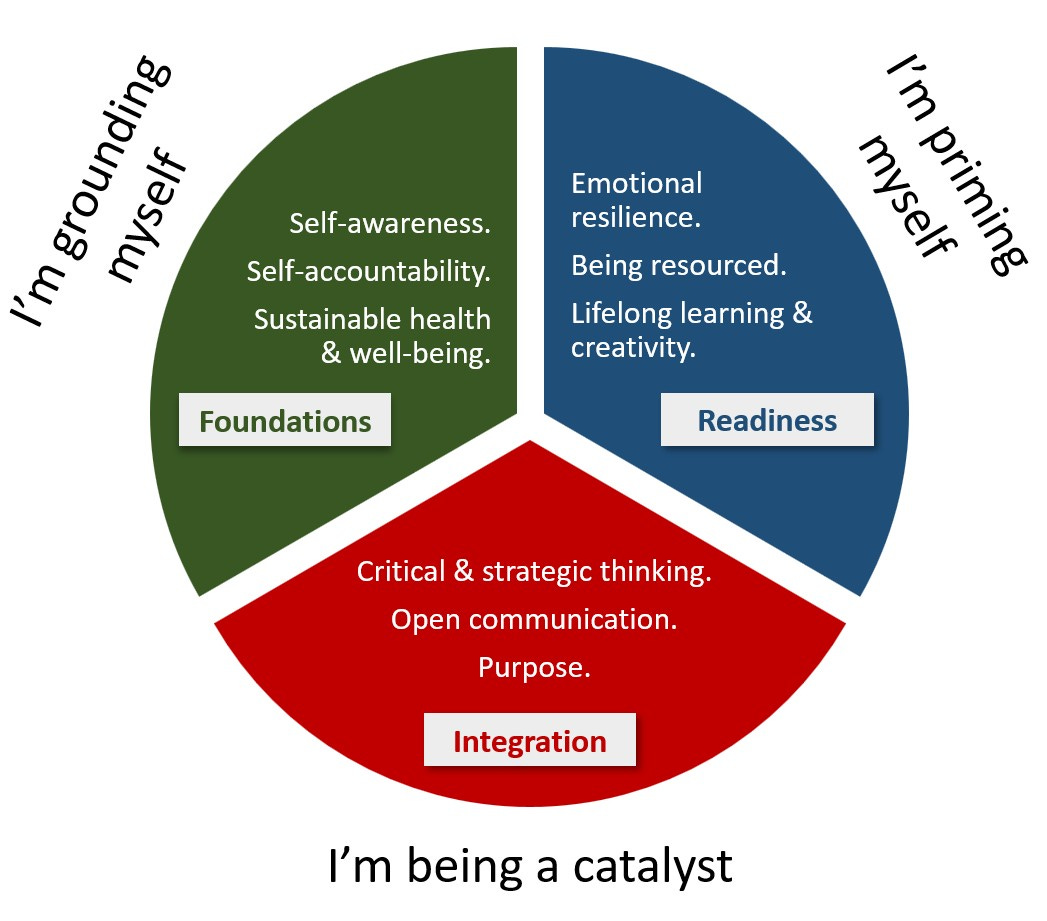
The three groups reflect rough categories of related attention, not a strict hierarchy.
The first group, Foundations, matter most when you are thrown off balance and need to find your feet again. They are about grounding yourself: who you are, what you are (and are not) responsible for, and what gives you a manageable, durable sense of well-being.
The second, Readiness, is when you need to stock up in preparation for what might happen next. This is priming yourself: your emotional range, your access to resources, and your capacity to keep learning.
The third, Integration, is where you are an agent of action, and it concerns how you bring yourself to bear on the world around you: how you think, how you communicate, and what your whole self is expressing at the moment of doing.
What follows is the quick-reference summary. Each of the nine aspects will be explored in depth in a separate article in this series, beginning tomorrow with Self-awareness. Those articles are for subscribers, and are free to access once you have signed up.
The Nine Aspects
Foundations: Grounding myself
Self-Awareness:
Noticing a personal pattern in the moment it is happening. Observing your own data: how you construct reality, the patterns you maintain, and the choices available to you. Being aware of your awareness (metacognition) and sorting experience. Without it, seniority amplifies confusion. With it, you shift from “What do I think?” to “How do I think?” That move turns confidence into judgment.
Self-Accountability:
Voluntary responsibility for your responses, and clear agency over what is under your control. The quiet decision to own what lies within your control and act from there. Distinct from blame or self-criticism: the discipline of acting with integrity in the part that is yours. When you are clear about what is yours, you stop over-owning what is not.
Sustainable Health and Well-being:
What makes you durable as a living system? This is the anchor point for all other development work. It is not entirely private: it applies at personal, social, and environmental scales. When energy, attention, and emotional capacity are depleted, learning narrows, and judgment becomes brittle. Noticing early warning signals and responding before they escalate is part of what healthy self-awareness enables.
Readiness: Priming myself
Emotional Resilience:
Staying coherent while in contact with difficulty: widening the range of choices in how you respond, rather than hardening yourself to it. This is a productive paradox: your capacity to maintain your shape as you change shape. Resilience is both innate and developed through key relationships. It is what keeps you emotionally available, able to listen, repair, and adjust, even under pressure.
Being Resourced:
The access and capacity to get what you need and replenish what you have used: practical (tools, budget, information), relational (networks, trust), and inner (attention, energy, self-compassion). The essential link between them is availability, which is a pattern, not an inventory. Performance is not from constant abundance; it is about renewability. Your biggest risk is resourcefulness depleted and masked as capability.
Lifelong Learning and Creativity:
Your ability to stay open in a world that refuses to stay still. Keeping yourself teachable, whatever your age or status; keeping yourself original and open to surprise. Creativity is specifically your ability to generate new distinctions when existing categories reach their limits. The biggest blocker: the quiet belief that senior people should already know.
Integration: Being a catalyst
Critical and Strategic Thinking:
A disciplined process of sense-making that ensures honest judgment and makes actions consistent with what truly matters. Critical thinking holds multiple perspectives at once: small details and broad horizons, evidence and interpretation, local and whole-system consequences. Strategic thinking views the organisation as a living network of relationships, constraints, incentives, and feedback loops. Together, they convert “having information” into “having a position.”
Open Communication:
A continuous process of creating safe conditions for sharing context, intention, and uncertainty. People first look for common ground, then share meaning. Much of what passes for communication is simply transmission: messages pushed and treated as job done. Open Communication is different: sense-making becomes jointly owned, coordination becomes a lighter touch. The higher you sit, the less likely you are to receive anything unfiltered in return.
Purpose:
Meaning made durable by the choices we make now that influence what happens next. Purpose lives in the present and looks in two directions simultaneously: as Mission (”What am I here to do?”) it links you to the past and the reason the work exists; as Vision (”Where do I go from here?”) today’s choices shape what comes next. Purpose is your best explanation of what you are doing, right here, right now.

What comes next
Starting tomorrow, I will be publishing a series of in-depth explorations of each of the nine aspects, one by one. Each will be a long-form piece, divided into three Parts (one per day).
Writing these will be a developmental tool for me. My aim is for part intellectual history, part critical analysis, and part personal reflection on what thirty years of working with managers and executives has taught me about that particular aspect of development.
These articles are for subscribers to my Substack, and I hope you will pass along the invitation to others who might find them useful. The series is a serious undertaking, so I will spread it out over time. If you are here because you are genuinely curious about your own development, and about the ideas that make that development possible, a subscription is the right next step. If you are here for something shorter and lighter, this framework summary above is yours to enjoy and reflect on..
The first article is on Self-awareness. It begins with a problem: most of us search for it as if we were using a flashlight to look for the dark.